Investment in Blood Cancer Research Has Saved Nearly 26 Million Years of Life, but Major Gaps in Survival Remain
Blood cancers account for about 10% of new U.S. cancer diagnoses, highlighting the need for continued research investment to advance treatments
(WASHINGTON, Sept. 1, 2026) — Over the past 75 years, advances in the treatment of major blood cancers have saved more than 25 million years of life in the United States, according to results of an analysis led by researchers at Blood Cancer United and published in Blood Advances. But the gains have not reached everyone equally: survival progress remains limited for people diagnosed with acute myeloid leukemia (AML) and across most major blood cancer types among Black individuals.
Blood cancers, including leukemia, lymphoma, and myeloma, represent approximately 10% of all cancer diagnoses in the United States, with more than 192,000 people expected to be diagnosed with a blood cancer this year. Unlike many other cancers, where screening and prevention have driven substantial declines in deaths, patients with blood cancer depend primarily on the discovery, development, and availability of new therapies.
Treatment Advances Have Saved 25.8 Million Life-Years
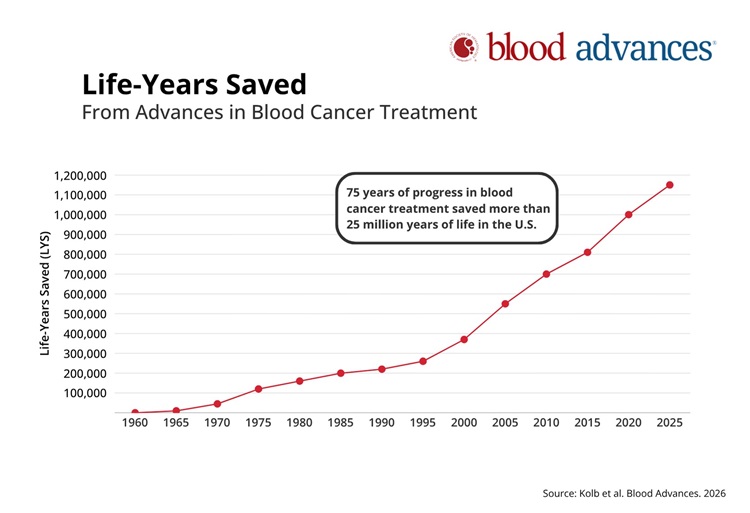
The research led by Blood Cancer United is a retrospective analysis to examine progress from 1949, when the first blood cancer chemotherapies emerged, through 2024. Using data from the National Cancer Institute’s Surveillance, Epidemiology, and End-Results (SEER) Program, they estimated life-years saved (cumulative years of life gained across patients due to therapeutic advances) by comparing actual life-years lost to projected life-years lost in the absence of treatment advances for different blood cancer subtypes.
“Many blood cancers are not curable, but are highly treatable, allowing patients with access to effective care to live longer, often relatively normal lives,” explained lead study author E. Anders Kolb, MD, president and CEO of Blood Cancer United, the world’s largest nonprofit funder of blood cancer research. “For this reason, time – more birthdays, more graduations, more celebrations – is an appropriate, meaningful measure of progress in this area.”
Based on their analysis, the researchers estimated that advances in blood cancer treatments have saved 25.8 million life-years over the past 75 years. Nearly 20 million of those years were saved among patients with Hodgkin lymphoma, acute lymphoblastic leukemia, and non-Hodgkin lymphoma. Conversely, the least life-years saved were for acute myeloid leukemia (~720,000), suggesting that there remains an unmet need for these patients, particularly those over the age of 65. Intermediate gains were observed in multiple myeloma, chronic lymphocytic leukemia, and chronic myeloid leukemia.
The analysis also identified persistent racial disparities in survival, with Black patients experiencing worse outcomes across every blood cancer subtype except multiple myeloma.
Research Investment is Critical to Save Millions More Life-Years
The researchers projected that, if the current pace of innovation continues, advances in blood cancer treatment will save an additional 18.9 million life-years between 2026 and 2040, while accelerating innovation and increasing treatment access could save an additional one million life-years by 2040.
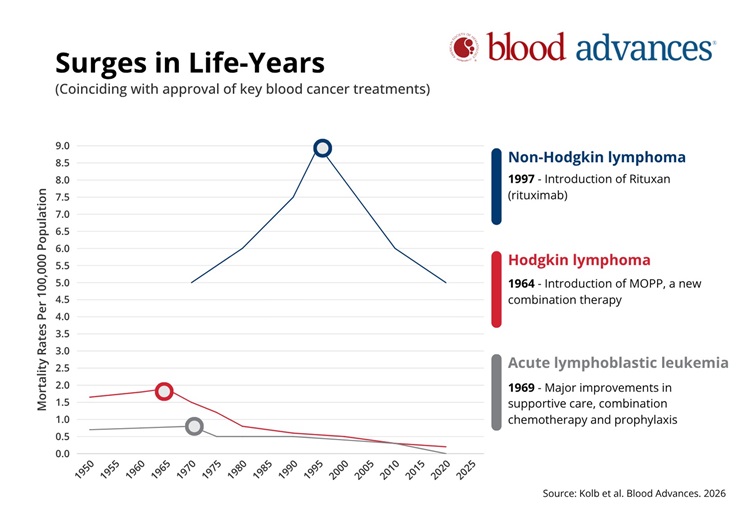
“These projections are not guaranteed,” said Dr. Kolb. “Progress requires sustained investment in research, continued vigilance to make sure that patients have access to the care they need, and ongoing advocacy. Our analysis showed clear inflection points in life-years saved following significant, practice-changing discoveries in blood cancer treatments. Decreased investment in research and barriers to affordable healthcare jeopardize this momentum and reduce the likelihood we will maintain the current trajectory.”
Study Limitations and Next Steps
Given the nature of the analysis, it has several limitations, namely its reliance on SEER data, which have changed over the years due to evolving disease classification and diagnosis processes. Additionally, the SEER tool does not provide data prior to 1975, requiring the researchers to use less robust data for back-extrapolations of disease mortality and incidence. Finally, the analysis did not include myelodysplastic syndromes or myeloproliferative neoplasms, potentially underestimating the total life-years saved.
Blood Cancer United plans to develop an annual report to measure progress across blood cancers and toward their bold goal of accelerating the trajectory to enable individuals with blood cancer to gain more than one million years of additional life by 2040.
The American Society of Hematology (ASH) (hematology.org) is the world’s largest professional society of hematologists dedicated to furthering the understanding, diagnosis, treatment, and prevention of disorders affecting the blood. Since 1958, the Society has led the development of hematology as a discipline by promoting research, patient care, education, training, and advocacy in hematology. Join the #Fight4Hematology by visiting hematology.org/fight4hematology.
Blood Advances (bloodadvances.org) is an online, open-access journal publishing more peer-reviewed hematology research than any other academic journal worldwide. Blood Advances is part of the Blood journals portfolio (bloodjournals.org) from the American Society of Hematology (ASH) (hematology.org).
Claire Whetzel, 202-629-5085
[email protected]