ASH Sets New Standards for Diagnosing Iron Deficiency
New guidelines aim to address gaps that leave millions without timely answers or care
(WASHINGTON, Sept. 16, 2026) — Iron deficiency is one of the most common health conditions in the world, but many people live with symptoms for months or years before receiving a diagnosis. To address this critical unmet need, the American Society of Hematology (ASH) issued new clinical guidance to improve how iron deficiency is recognized and diagnosed across key populations, including adults, young children, menstruating and pregnant individuals, and people with inflammation.
ASH’s new evidence-based clinical practice guidelines address long-standing challenges in diagnosing iron deficiency, including variation in testing practices, inconsistent thresholds, and clinical scenarios in which iron deficiency can be difficult to identify. Iron deficiency is diagnosed through blood tests that measure ferritin levels, and ASH’s new guidelines recommend higher ferritin thresholds to help clinicians identify iron deficiency earlier and more accurately.
Iron deficiency affects an estimated one in three people, yet many go undiagnosed and untreated despite widespread treatment options. Iron deficiency can progress to iron deficiency anemia, a condition that impairs oxygen transport in the body and, if untreated, can lead to life-threatening complications.
“Iron deficiency and iron deficiency anemia are among the most common yet neglected medical conditions globally,” said ASH President Robert S. Negrin, MD. “Many patients live with symptoms such as fatigue, weakness, dizziness, or difficulty concentrating for months or even years before iron deficiency is recognized. These guidelines are an important step toward closing that gap by helping clinicians diagnose iron deficiency earlier and more accurately, so more patients can receive the care they need.”
Iron Deficiency: Common, but Underdiagnosed
Iron is stored in the protein ferritin and is essential for producing hemoglobin — a molecule that carries oxygen throughout the body — and for the health of the brain, immune system, muscles, skin, hair, and nails. Iron deficiency occurs when the body’s iron stores are too low, leading to symptoms such as lack of energy, shortness of breath, rapid heartbeat, headache, and pale skin. If untreated, it can progress to iron deficiency anemia, which impacts hemoglobin levels and is the most common hematologic condition worldwide.
Iron deficiency affects an estimated 10 million adults in the U.S. and 2 billion people worldwide. Individuals at higher risk of developing iron deficiency include those who are pregnant or menstruating, children, and people with gastrointestinal conditions, dietary restrictions, blood loss, or other chronic health conditions. However, many cases go undiagnosed, with up to 70% of cases missed among high-risk populations due to limited screening and variability in diagnostic reference ranges.
New Approach Aims to Catch Overlooked Cases of Iron Deficiency
Iron deficiency and iron-deficiency anemia are diagnosed with blood tests. Iron deficiency is diagnosed when a person’s ferritin levels are considered too low. To improve diagnosis of the condition, ASH developed guidance that provides new ferritin thresholds — or cutoff numbers below which patients do not have enough iron in their bodies.
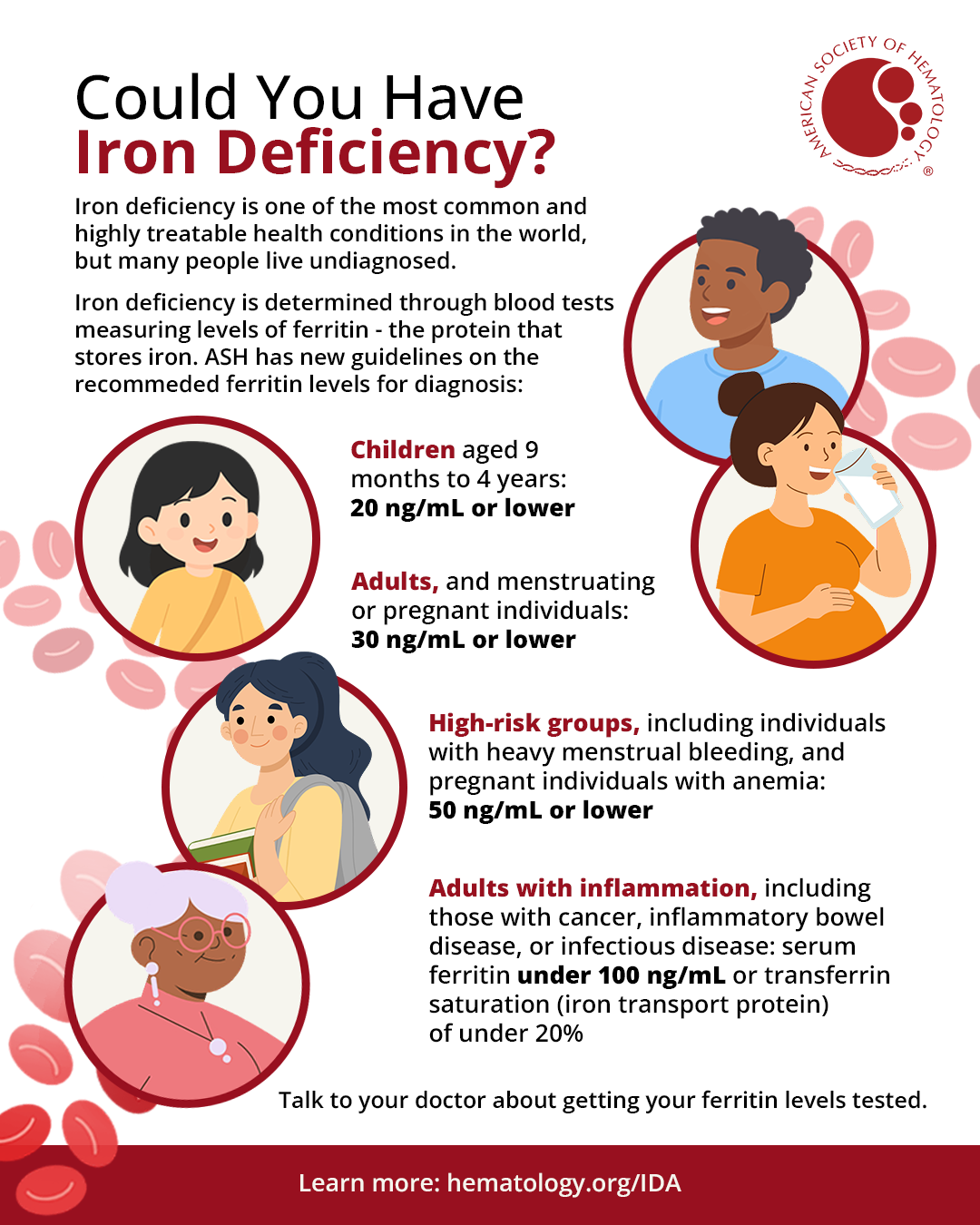
New serum ferritin thresholds for diagnosing iron deficiency:
- Children aged 9 months to 4 years: 20 ng/mL or lower
- Adults, and menstruating or pregnant individuals: 30 ng/ml or lower
- High-risk groups, including individuals with heavy menstrual bleeding and pregnant individuals with anemia: 50 ng/mL or lower
- Adults with inflammation, including those with cancer, inflammatory bowel disease, or infectious disease: serum ferritin under 100 ng/mL or transferrin saturation (iron transport protein) of under 20%
“These updated ferritin thresholds provide clear guidance in an area where consensus has been lacking,” said guideline chair Jacquelyn M. Powers, MD, MS, section chief of hematology at Texas Children’s Hospital and associate professor in the department of pediatrics at Baylor College of Medicine. “We hope these recommendations empower patients to better understand and ask for the testing they need and that health systems adopt these thresholds for diagnosis.”
What Should Patients Know?
The guidance clinicians use for diagnosing iron deficiency has changed. The recommended ferritin cutoff numbers for diagnosis are now higher across all populations, meaning that some people who were previously considered not to have iron deficiency based on their test results may actually have iron stores low enough to meet the criteria for iron deficiency, especially if their ferritin level was close to the old cutoff.
Individuals should talk with their doctor about having their ferritin levels tested according to the new cutoff numbers for diagnosis, especially if they are at higher risk for developing iron deficiency. Learn more about iron deficiency, the risks, causes, signs and symptoms, and more.
ASH is Committed to Improving Diagnosis and Treatment
ASH is working to close critical gaps in how iron deficiency and iron deficiency anemia are recognized, diagnosed, and treated. Through its Iron Deficiency Initiative, ASH is advancing advocacy, quality improvement, and education to help ensure more people affected by iron deficiency receive timely, accurate diagnoses and appropriate care. Additional ASH guidance on the treatment of iron deficiency is anticipated in 2027.
As part of this broader effort, ASH is also developing its Iron Deficiency Blueprint, a strategic workplan to help reduce the global burden of iron deficiency and iron deficiency anemia. Together, these efforts reflect ASH’s commitment to elevating iron deficiency as a major public health issue and improving outcomes for patients worldwide.
About ASH’s Clinical Practice Guidelines on Diagnosis of Iron Deficiency
ASH’s evidence-based recommendations were published in ASH’s peer-reviewed journal, Blood Advances. The guidelines were developed by experts across medical specialties, with input from a patient who has experienced an iron deficiency diagnosis firsthand.
Additional resources, including a visual summary and teaching slides, can be found on ASH's website.
About the American Society of Hematology
The American Society of Hematology (ASH) (hematology.org) is the world’s largest professional society of hematologists dedicated to furthering the understanding, diagnosis, treatment, and prevention of disorders affecting the blood. Since 1958, the Society has led the development of hematology as a discipline by promoting research, patient care, education, training, and advocacy in hematology. Join the #Fight4Hematology by visiting hematology.org/fight4hematology.
The Blood journals (https://ashpublications.org/journals) are the premier source for basic, translational, and clinical hematologic research. The Blood journals publish more peer-reviewed hematology research than any other academic journals worldwide.
Contact:
Claire Whetzel, 202-629-5085
[email protected]